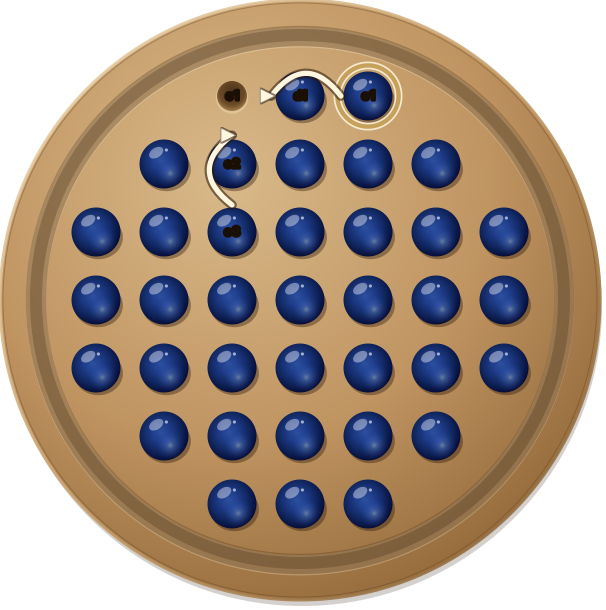
The 37-hole French board adds four holes to the English shape. Our solvable opening empties c1 and finishes at e1 in 35 jumps. A d4 vacancy cannot finish with a single marble anywhere.
The French board, where it started
Before there was an English board, there was this one. The 37-hole French board is the older relative of the cross you may already know: the same shape with four extra holes tucked into the corners, so the whole thing looks almost round.
It keeps a secret that surprises almost everyone who tries it. Empty the centre hole, as you would on the English board, and no sequence of jumps will ever leave a single marble, on any hole at all. A counting argument settles it, and no amount of cleverness gets around it. The French board is a puzzle that asks you to choose your opening hole carefully before you have jumped at all.
The opening we use here is c1, near the top edge, and the last marble finishes at e1, two holes along. It takes 35 jumps. Those two holes look close together, which is exactly what makes the finish feel cruel when you miss it by one.
How to play the French board
The French board has 37 holes. Columns run a to g and rows 1 to 7, with the empty hole at c1 to start. Only two first jumps are possible: e1 over d1, or c3 over c2, both landing on c1.
- Each jump needs two neighbouring marbles in a straight line and an empty hole immediately beyond them. The jumped marble is removed; every jump reduces the count by one.
- On square grids, jump horizontally or vertically. On the triangle, use any of the six directions parallel to its three sides. A diagonal on a square grid is never legal.
- The marked hole is the required finish. One marble somewhere else is a different result, not a win in this target puzzle. You can undo a jump and explore a different route.
- Our counter records individual jumps. Mathematical books sometimes group several jumps by the same marble into one “move”; those totals are not comparable.
Click or tap a marble. If only one jump is possible it happens at once; if there are several, outlined holes show where the marble can land and you pick one. You can also drag a marble onto a hole, or use the keyboard: arrow keys to move, Enter or Space to select and jump, Escape to clear, Ctrl or Cmd with Z to undo.
How to win the French game
Thirty-six marbles means 35 jumps. The target ring is on e1. The last marble has to come to rest there; any other single marble is So close.
The French board solution
The replay of our c1 to e1 opening is on the Solutions page. It is one of many possible routes; if your own line breaks, the replay is a way to see where yours went wrong.
Questions people ask
Is the French board harder than the English one?
The rules are the same. It is longer, 35 jumps against 31, and its famous centre opening cannot be finished, so you start from c1 instead.
Can I start from a different hole?
Some openings work and some do not. The Puzzles and the Daily use other positions on the same board, so you will meet several of them there.