Peg Solitaire · How to play
Jump a marble over its neighbour into an empty hole. Remove the marble you jumped over. Keep going until one remains at the marked target. Play six classic boards, try today’s shared puzzle, or learn one small ending at a time.
A game from the court of Louis XIV
In the summer of 1697 the French magazine Mercure galant did something unusual: it printed the rules of a game, a drawing of its board and a handful of problems to solve. The game, it said, was the fashion at court, in the years of Louis XIV.
The picture most of us know from that time is an engraving published by Berey. It shows Anne de Rohan-Chabot, princesse de Soubise, with the board in front of her. The sources do not say she invented the game, and we do not either. But she has the right look for it, a quiet face over a puzzle, which is why she watches from the corner of this site.
More than three centuries later the rules have hardly moved. Thirty-two marbles, one empty hole, and a single kind of move: jump a neighbour, take it off the board. What changes is how it feels. The first few jumps are easy and a little careless. Somewhere past the middle the board goes quiet, every marble starts to matter, and you catch yourself holding your breath over a jump you were sure about ten seconds ago.
The game has travelled under many names, Brainvita in India, Senku in Spanish, Resta Um in Portuguese, Solitaire in French. It is the same puzzle every time, and it still ends the same way: one marble left, and the small private satisfaction of having done it.
What is peg solitaire?
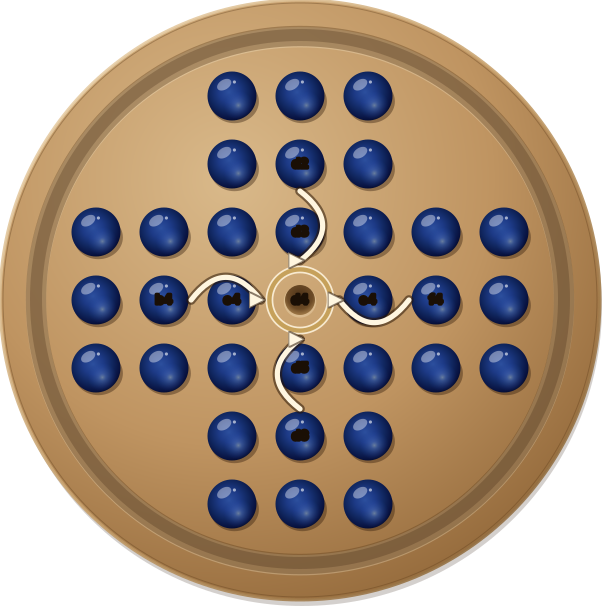
Peg solitaire is a puzzle for one player, which is all the word solitaire means here. A board of holes is filled with marbles, or with pegs if you prefer wood, except for a single empty hole. Pegs and marbles are two ways of playing the same puzzle, and plenty of people simply call it the peg game.
Your only move is the jump: a marble leaps over its neighbour in a straight line into the empty hole just beyond, and the marble it jumped over is taken away. Every jump removes exactly one marble. The aim is to keep jumping until one marble is left.
It is not the card game. In Britain that one is called Patience, and it has nothing to do with this board.
How to play peg solitaire
The rules fit in four lines, and then it is all in your hands.
- Each jump needs two neighbouring marbles in a straight line and an empty hole immediately beyond them. The jumped marble is removed; every jump reduces the count by one.
- On square grids, jump horizontally or vertically. On the triangle, use any of the six directions parallel to its three sides. A diagonal on a square grid is never legal.
- The marked hole is the required finish. One marble somewhere else is a different result, not a win in this target puzzle. You can undo a jump and explore a different route.
- Our counter records individual jumps. Mathematical books sometimes group several jumps by the same marble into one “move”; those totals are not comparable.
Click or tap a marble. If only one jump is possible it happens at once; if there are several, outlined holes show where the marble can land and you pick one. You can also drag a marble onto a hole, or use the keyboard: arrow keys to move, Enter or Space to select and jump, Escape to clear, Ctrl or Cmd with Z to undo.
Holes have names, like squares on a chessboard: letters across, numbers down from the top. A jump from d2 to d4 moves the marble on d2 over d3. The names matter when you want to write a route down or compare it with a replay.
How to win
Every jump removes one marble, so a board that starts with 32 marbles needs exactly 31 jumps to leave one. On this site each board also has a marked target hole, and the win is that last marble landing on it. One marble anywhere else is called So close, not a win; the Puzzles and the Daily follow the same rule.
Peg solitaire strategy: tips that help
- Think backwards from the target. The last jump has to land on it, so before the end exactly two marbles must be lined up with it. On the English board those pairs are few; work out which, then ask what has to be true one jump earlier.
- Keep your marbles connected. A marble with no neighbour cannot jump and cannot be jumped, and unless another marble can reach it, that is a lost game. Clearing a whole outer arm too early is the usual way to get one.
- Look at the whole board before each jump, not just the marble in your hand. A tidy local move can cut off a region you needed later.
- Practise the endings first. The Puzzles give you six stages per board, from a single jump up to the full opening.
- Use Undo freely. Nobody finds the route in one go; try a line, see where it breaks, take it back and try the other.
- Use symmetry. Rotating or flipping a board turns one solution into another, and on a board with a central opening your first jump has several choices that are really the same move.
Which board should I start with?
The English cross, 33 holes and 31 jumps, is the classic and the one most people mean by peg solitaire. If you have a few minutes and want something small, the 15-hole triangle takes 13 jumps. The 36-hole square takes 34, the French board with 37 holes takes 35, the 41-hole diamond takes 39 and the 45-hole Wiegleb cross takes 43. Longer is not always harder, but there is more to keep in your head.
Questions people ask
Can every peg solitaire game be solved?
No. It depends on where the empty hole starts and where you want to finish. The English cross can start and finish in the centre, but on the French board you can never finish with one marble if you start with the centre empty, and on the triangle you cannot start with a1 empty and finish on b3. That is why each board here has an opening that is known to work.
Can I play peg solitaire online for free?
Yes. Everything here is free to play, with no account, no ads and no analytics scripts. Your progress, finished puzzles and statistics are kept in your browser on this device, so clearing the site’s data will clear them.
Is there a peg solitaire solver?
There is no box where you type a position in, but the game has a solver of its own. The Hint button shows a jump from a route the game has checked can still win. If the search proves the target can no longer be reached, the game says so, which tells you to undo; if it reaches its search limit, the answer is simply unknown. A hint is marked in your result and keeps that game out of your best time.
Where can I find the solution?
There are many. The Solutions pages, linked from the footer, replay one verified route per board from its standard opening, to compare with your own.
Can I print a board and play with real counters?
Yes. The Print & Teach page prints the boards and puzzle sheets. Put a coin or button in every hole except the empty one and play exactly the same game.